

Quick Answer:
In Dubai, mobile friendly website design is no longer an optional feature; it’s the primary way your customers will find and judge you. By 2026, over 80% of web traffic in the UAE will come from smartphones. A truly mobile-first site for Dubai must load in under 2 seconds on local mobile networks, cater to a multi-lingual audience on small screens, and convert visitors who are often on the move.
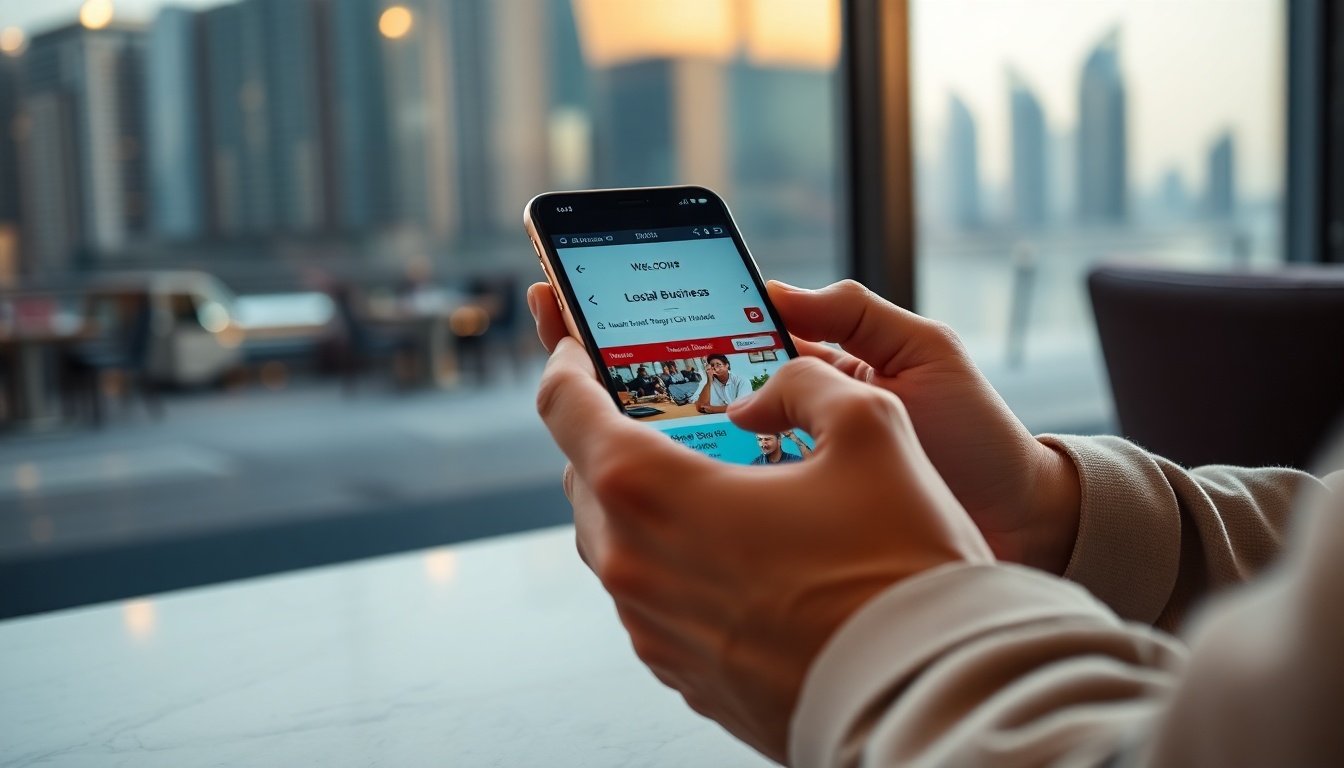
You are probably reading this on your phone right now. So is your next customer. I was sitting in a cafe in Business Bay recently, watching people. For twenty minutes, not a single person pulled out a laptop. Every interactionchecking a menu, finding a location, making a bookinghappened on a six-inch screen.
That is the reality for your business in Dubai. The search for mobile friendly website design dubai is not about checking a technical box. It is about survival in a city that lives on its phone. The old approach of building a desktop site and then shrinking it down is a recipe for irrelevance. Your audience has already moved on.
The Real Problem
Here is what most people get wrong about mobile friendly website design in Dubai. They think it is just about responsive templates. They buy a theme that “looks okay” on a phone and call it a day. The real problem is not how it looks, but how it behaves for a user in Dubai.
I have audited dozens of local sites that pass a basic mobile-friendly test. Yet, they fail the moment you use them. The images are massive files that choke on a Du network in a crowded mall. The contact button is buried under three scrolls. The Arabic text is awkwardly formatted, breaking the flow.
Worst of all, they ignore context. A user in Dubai on a phone is often in a hurry, in a taxi, or comparing three options side-by-side. Your mobile site is not just a smaller version of your brochure. It is a digital concierge that needs to provide instant answers, directions, and a frictionless path to a call or a sale. Treating mobile as an afterthought is the single biggest strategic error I see businesses make here.
A client of mine ran a high-end home furnishing store in Jumeirah. Their website was beautiful on a desktop. On mobile, it took 11 seconds to load the gallery page. We discovered their “mobile-friendly” site was loading 15 high-resolution images per product, each over 4MB. For a customer on mobile data, that was a deal-breaker. They were losing 70% of their mobile visitors before the page even finished loading. The fix wasn’t a new design; it was a complete rebuild of their image delivery system for mobile-first. Their conversions from phone users tripled in two months.
What Actually Works
Forget about templates for a moment. Start with the person holding the phone. What do they need from you in the first ten seconds? In Dubai, it is usually one of three things: your location, your phone number, or your price. Your mobile site’s job is to deliver that instantly.
Speed is not a technical metric; it is a customer service promise. You need a hosting solution that delivers content from within the region. You must compress and serve images based on the user’s device. A one-second delay can cost you 30% of your potential customers. I tell clients to design for the weakest network signal in a Dubai Metro tunnel, not the perfect Wi-Fi in their office.
Navigation must be thumb-friendly. Menus should collapse into clear icons. Buttons need to be large enough to tap without zooming. For a bilingual audience, the language switch must be the most prominent element, not a tiny flag hidden in the footer.
Finally, integrate with how people here communicate. A “Click to Call” button is more valuable than a fancy contact form. A “Get Directions” link that opens directly in Google Maps or Waze is pure gold. Your mobile site should feel less like a website and more like a helpful tool that lives in their pocket. That is the shift in thinking that separates a good mobile experience from a great one.
“In Dubai, your mobile website is your new storefront. If the door is hard to open, the lights are dim, and the assistant is slow, your customer will just walk across the digital street to your competitor.”
Abdul Vasi, Digital Strategist
Common Approach vs Better Approach
| Common Approach | Better Approach for Dubai |
|---|---|
| Using a generic responsive template. | Custom designing for the mobile journey first, then adapting to desktop. |
| Testing the site only on office Wi-Fi. | Testing performance on 4G/5G across different Dubai locations (Marina, Deira, Silicon Oasis). |
| Hiding the phone number in the contact page. | Placing a persistent, tappable “Call Now” button in the header and sticky footer. |
| Loading the same high-res images for all devices. | Implementing advanced image compression and serving WebP/AVIF formats based on device. |
| Treating Arabic translation as a text swap. | Designing a fully mirrored (RTL) layout with culturally relevant imagery and fonts. |
Looking Ahead to 2026
By 2026, the concept of a “mobile-friendly” site will be redundant. Every site will be built for mobile first by default. The differentiation will be in how intelligently it adapts. I see three specific shifts coming for Dubai.
First, voice search will move from novelty to necessity. “Hey Google, find a nearby interior designer” will be a primary search method. Your site’s content structure needs to answer these conversational queries directly. Second, mobile payments and wallet integrations (like Apple Pay, Samsung Pay) will be expected on e-commerce sites. The checkout on a phone must be a two-tap process.
Finally, with 5G becoming ubiquitous, we will see richer, app-like experiences directly in the browser. But the winners will be those who use this power for instant utility, not just flashy graphics. The core principle remains: respect the user’s time, data, and immediate intent. That will never change.
Frequently Asked Questions
Q: How much does a mobile-friendly website cost in Dubai?
It depends entirely on your starting point and goals. A simple refresh of an existing site might start around AED 8,000, while a complete, custom mobile-first build for a business with complex needs can range from AED 25,000 to AED 60,000+. The investment should be measured against the mobile revenue you’re currently losing.
Q: Is a responsive WordPress theme enough for my Dubai business?
A theme gives you a mobile-looking layout, but rarely delivers true mobile performance. Most are bloated with code and features you don’t need, which cripples loading speed. It’s a start, but for a competitive edge, you need custom optimization focused on the Dubai user’s experience.
Q: How can I check if my current website is truly mobile-friendly?
First, use Google’s Mobile-Friendly Test tool. Then, go deeper. Use your own phone on mobile data (not Wi-Fi) and time how long it takes to find your phone number or make a purchase. Ask a friend who speaks only Arabic to navigate the site. That real-world test is far more revealing.
Q: What’s more important for mobile, design or speed?
Speed is a fundamental part of the design. A beautiful design that doesn’t load is worthless. Prioritize core speed metrics firstgetting your key information to load almost instantly. Then, layer on the visual design in a way that doesn’t compromise that initial speed.
Q: Should I build a separate mobile app instead?
For most businesses, no. A well-built, progressive web app (PWA) gives you app-like features (push notifications, home screen icon) without forcing users to download anything. It’s more cost-effective and reaches 100% of your mobile visitors immediately. Reserve a native app for very specific, frequent-use cases.
Look, the direction is clear. The user’s phone is the center of their digital world. Your business needs to be present and effective in that space. This isn’t about chasing the next trend. It’s about meeting your customers where they already are, with a experience that makes their life easier.
Waiting to “update the site next year” means another year of missed connections and frustrated potential clients. The gap between businesses that get this and those that don’t is widening every day. Your move to a proper mobile-first presence isn’t just a design project; it’s a strategic business decision for growth in Dubai.
